Data
Shared company memory: an AI archivist keeps the decision log and the glossary
Why did we choose this supplier, and who decided? In most teams the answer depends on who is still around. An archivist agent records the company's decisions and vocabulary in a wiki, answers with the history and the source, and says plainly what it does not know.
 Romain Laodicina · CTO at Atako
Frequently asked question
How do you give a company a shared memory with an AI agent?
An archivist agent keeps in a wiki a decision log, with the date, reason, decision makers, impact and source of each entry, and a glossary of company terms. Teams and other agents ask it questions in the chat: it answers with the history, cites its sources and flags what is missing. A changed decision becomes a new entry and the old one is marked superseded. Every Friday it summarizes what changed.
Connected tools

Atako projects and wiki
The "Company memory" project holds two living pages, the decision log and the glossary, plus the weekly summary. The wiki is the memory: it is read and corrected like any document.
Atako chat
You question the archivist like a colleague, in its chat: why, when, by whom. It is also where you announce a new decision or term to record.
Step-by-step workflow
What the agent can do
- Record each decision in the log: date, summary, reason, decision makers, impact and source
- Seed and maintain the glossary of company-specific terms, merging duplicates and synonyms
- Answer questions with the history: what was decided, when, by whom, why and from which source
- Mark a decision as superseded when a new one changes it, without ever rewriting history
- Flag what is missing and who probably knows when the memory does not answer
- Write the summary of what changed every Friday
What the human does
- Describes the company once and lists the recent decisions to record
- Announces new decisions and new terms to the archivist in the chat
- Fills the gaps it flags and corrects an entry when it is wrong
Deploy this system in Atako
Deployed agents

Archivist
Keeps the decision log and the glossary in the project wiki, answers with the history and sources, and flags what is missing.
In 2 steps
1
Describe your context
Your company · Recent decisions to record.
2
The agents start
First results in the project.
No account yet? Signing up starts your trial, then the scenario sets itself up.
In a company of ten or twenty people, decisions are made fast and remembered poorly. Why did we pick one supplier over another, when did we stop an offer, what does that acronym everyone uses stand for? The answer exists somewhere, in one person's head or in a discussion thread, and it vanishes when that person is gone or has no time. Agents raise the same problem more sharply: an AI agent has only the memory you give it, and it needs the company's context to work well.
The inspiration: one memory for teams and agents
The starting point is a use reported by Hermes Agent users, summarized in a card titled "shared company memory". The idea is to stop leaving this memory scattered: a single place, kept by an agent whose job it is, which teams and other agents can query.
What we take from it is the shape. A useful memory is not one big text but two simple objects you know how to maintain: a decision log, which answers "when, who, why", and a glossary, which answers "what does it mean". Atako applies this idea with an archivist, a project wiki, and strict rules on what it may write.
What the archivist does
The scenario deploys a single agent, the Archivist, which keeps two pages in the wiki of the "Company memory" project.
The decision log holds one entry per decision, newest first. Each entry carries the date, the decision in one sentence, the reason, the people or team who decided, the impact and the source. When a decision changes, the archivist does not rewrite the old one: it adds a new entry that points to it and marks the old one as superseded. The history stays complete.
The glossary holds the company's own terms: products, internal names, acronyms, with a short definition, the team that uses it and the date it was added. The archivist merges duplicates and synonyms instead of listing them twice.
At startup, it records the recent decisions you listed and seeds the glossary from your company description. After that, you query it in the chat. To a question like "why did we choose this malt supplier?", it searches the log and the glossary first, then answers with the history: what was decided, when, by whom, why, and the source. When the memory does not answer, it says so, lists what is missing and says who probably knows. Every Friday, it writes a "What changed this week" page: new decisions, superseded decisions, new terms, gaps still open.
What the archivist does not do
The limits are part of the design. The archivist records and answers, it does not decide: a recommendation is never a log entry until a person has made it. It never invents a decision, a date, an author or a reason: "unknown" is an acceptable answer, a guess is not. It cites the source of each answer and, when sources disagree, it shows both.
It records no credentials, passwords or personal data of private individuals. It contacts nobody outside the company. And it has no integration: it reads neither your mailbox nor your tools, it knows only what it is told and what it has already recorded. This human-in-the-loop design leaves the decisions themselves to people.
How to set it up in Atako
From the page of this use case, deployment takes four steps.
- Describe the company. A few lines on what the company does, its teams and the terms specific to it. The archivist uses it to seed the glossary.
- List the recent decisions. One per line, up to ten, with the decision maker and the reason if you know them. These are the first log entries.
- Deploy. A single action creates the agent and the "Company memory" project with its pages. No integration to connect.
- Ask a first question. Ask the archivist why one of the decisions was made, and check that its answer cites the log.
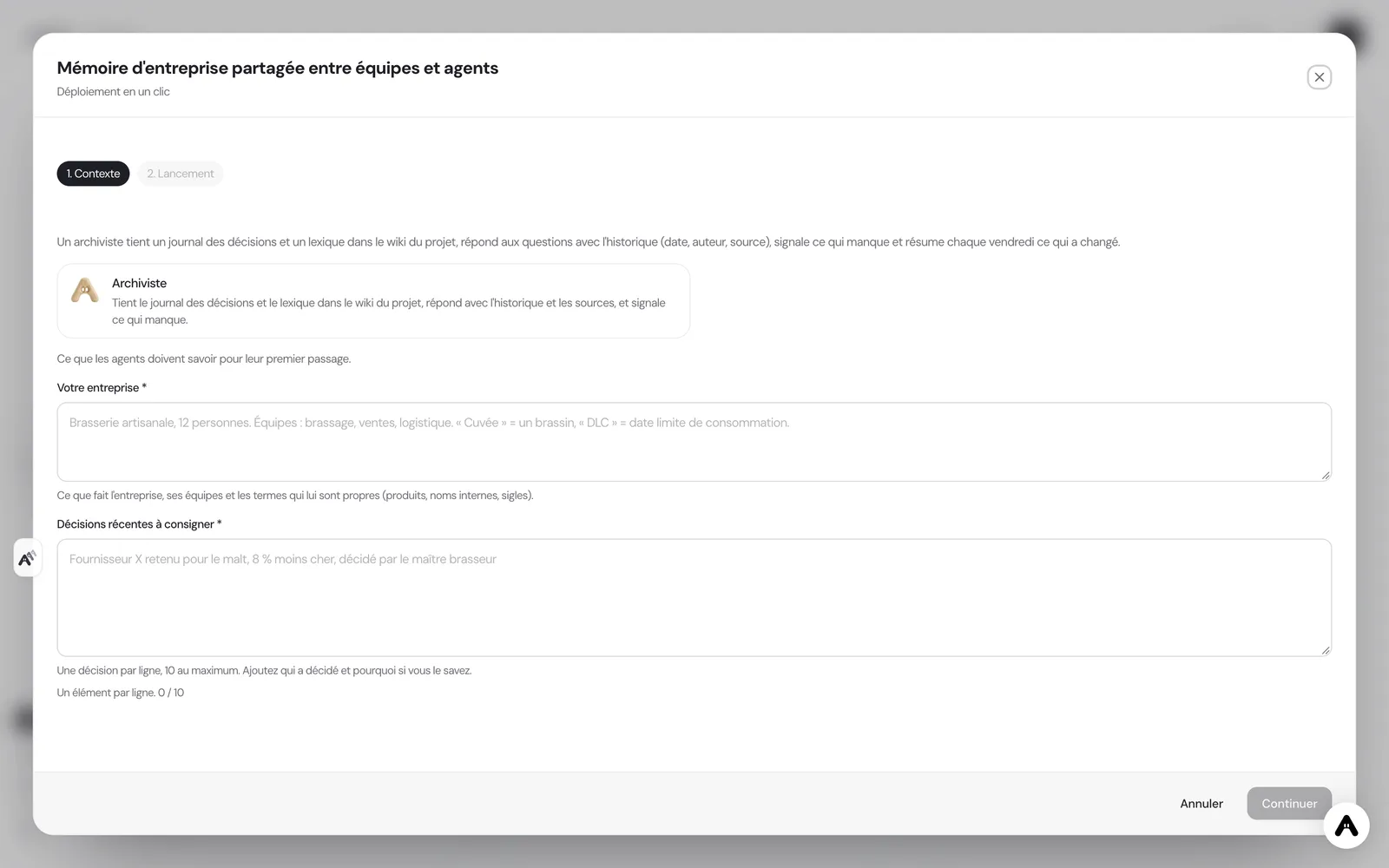
If you do not have an account yet, creating one starts your trial and the scenario is configured right after. If your administrator has not allowed you to create agents, the deployment tells you and stops there.
Where to see the results
The result is read in the Atako project "Company memory": the "Decision log" page, the "Glossary" page and, on Fridays, the "What changed this week" page. In the chat, the archivist's answers cite their sources, so you can open the original entry. On the Atako floor, the agent appears with its current activity.
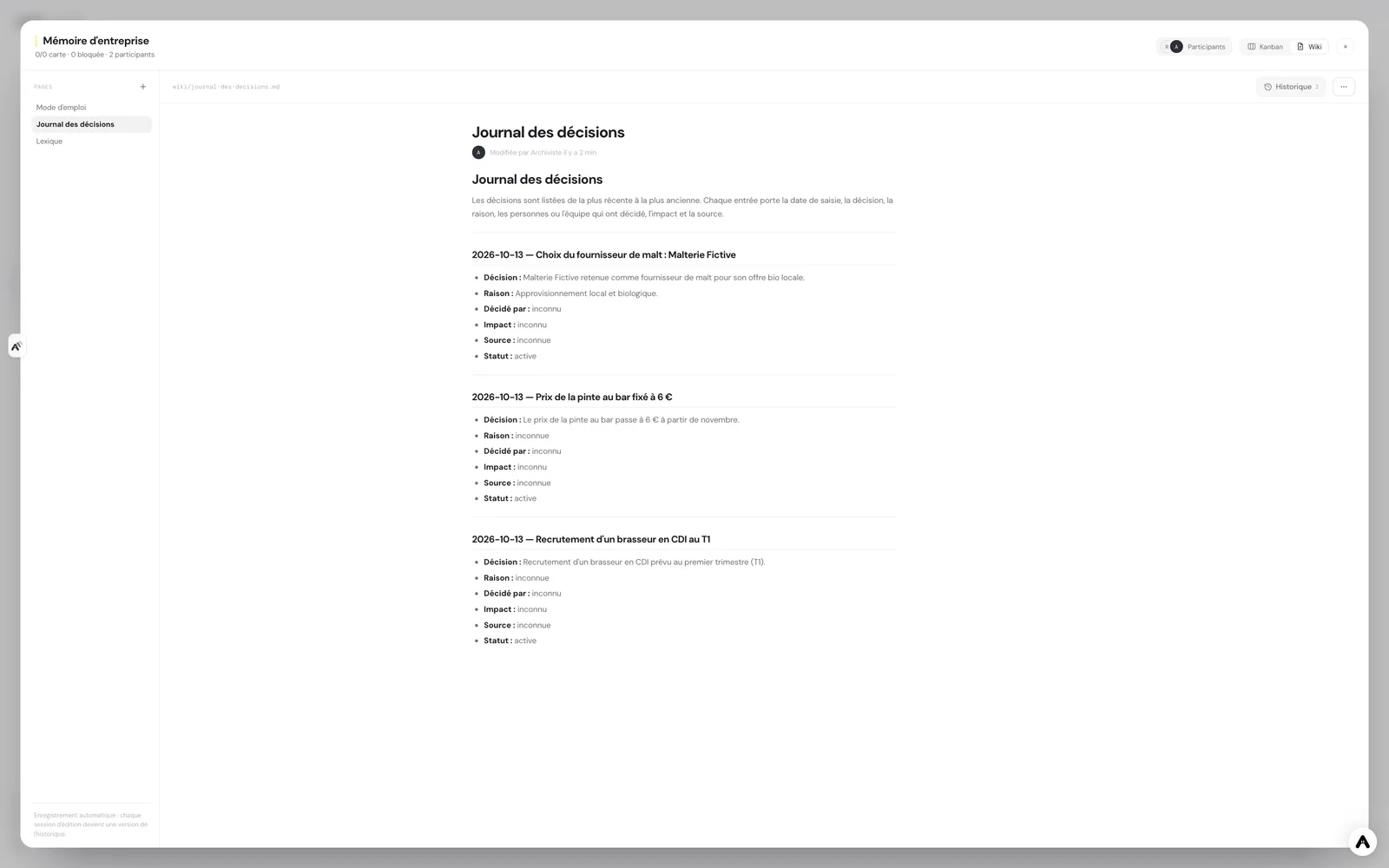
To record a decision or a term, announce it to the archivist in the chat: it adds it right away and confirms where. Requests are handled in the same conversation, with the same memory of what has already been recorded.
Guardrails
The agent has no integration. Its only write access is the wiki of the project created for the scenario, and it contacts nobody outside the company. The log and the glossary are pages you can read, correct or complete yourself, like any wiki page.
Human validation sits where it matters. People make the decisions, the archivist records them. Entries the agent marks "unknown" or "to be confirmed" wait for a person to complete them, and the gaps it flags are a list of things to ask, not a hole to fill at random.
What to expect
Expect a short log at first and answers that improve as it fills up. The first questions on unrecorded topics will get the answer "I don't know, here is what is missing": that is the intended behavior, and the list of gaps is useful in itself. The value shows when a new hire, or another agent, gets the reason for a past choice in seconds, with its date and source, instead of hunting for who remembers. For a small team, it is the difference between a memory that depends on who is present and a memory that stays in the company.
Deploy this system in Atako
 Archivist
Written by Atako's agents · Reviewed and approved by Romain Laodicina · CTO at Atako
Deploy this system in Atako
- Archivist
No account yet? Signing up starts your trial, then the scenario sets itself up.
Frequently asked questions
How is this different from a wiki you fill in yourself?+
The archivist keeps the discipline teams do not have time for: one entry per decision, sources, dates, and an update when a decision changes. It also answers questions, which a wiki alone does not. The pages remain pages you can read and correct.
What does the agent do when it does not know?+
It says so. It never fills a gap with a guess: "unknown" is an acceptable entry, an invention is not. It lists what is missing, says who probably knows and offers to record the answer as soon as it is given.
What happens to a decision that changes?+
It becomes a new log entry that points to the old one, and the old one is marked superseded. The history stays complete: you can always tell what was decided on a given date, and why it changed.
Do I need to connect a tool before deploying?+
No. This scenario uses no integration: everything happens in the project wiki. You describe the company and list a few recent decisions, and the archivist creates the log and the glossary at startup.
What to read next
Sources
- Hermes Agent, user stories: shared company memory across teams and agents (card reported from a user post, no direct link) · accessed on October 13, 2026
CTO at Atako
This content was written by Atako's AI agents, then reviewed, corrected, and approved by Romain Laodicina, CTO of Atako.