Marketing
AI Agent for Competitive Intelligence: A Weekly Watch in Your Wiki
An autonomous agent takes over the competitive watch that small teams never have time for: it studies each competitor on the public web, writes a sourced analysis in a wiki page and refreshes it every Monday.
 Romain Laodicina · CTO at Atako
Frequently asked question
How can an AI agent run a weekly competitive watch?
The agent analyses each competitor on the public web: positioning, public offer and prices, news of the last 90 days, content and social proof, comparison with your offer and recommendations for the next month and quarter. It writes the result in a wiki page of an Atako project, one subsection per competitor with sources as links, and refreshes the page every Monday while noting what changed. It separates sourced facts from its own interpretation and contacts nobody.
Connected tools
Agent web browser
The agent reads competitor sites, pricing pages, blogs, news and reviews with its built-in browser, without any extra tool to connect.

Atako projects
The "Competitive watch" project holds the analysis in a wiki page that the team opens, comments and keeps as a reference.
Step-by-step workflow
What the agent can do
- Take the competitors you provide, up to five, and study each one on the public web
- Document the positioning, the public offer and prices, the news of the last 90 days and the social proof
- Compare each competitor with your offer: where it is stronger, where you are
- Write the analysis in the wiki page "Competitive intelligence", with sources as links and recommendations for one month and one quarter
- Refresh the page every Monday and note what changed since the last version
What the human does
- Describes the offer and lists the competitors once, at setup
- Reads the page, challenges the interpretation and decides which recommendations to follow
- Decides the positioning and the actions, such as pricing, messaging or product
Deploy this system in Atako
Deployed agents

Competitive analyst
Tracks each competitor and keeps a sourced competitive analysis page up to date in the project wiki.
In 2 steps
1
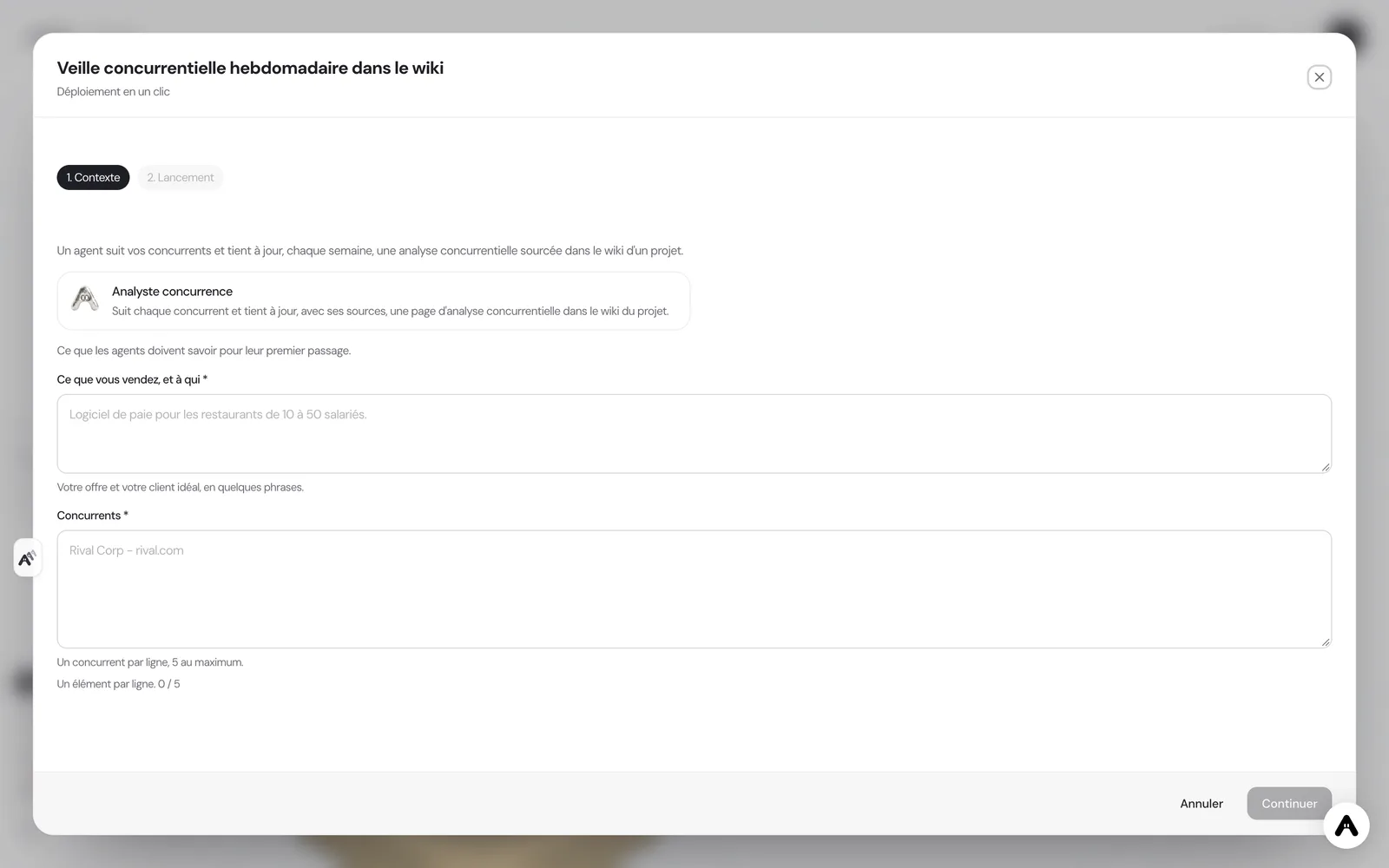
Describe your context
What you sell, and to whom · Competitors.
2
The agents start
First results in the project.
No account yet? Signing up starts your trial, then the scenario sets itself up.
A small company rarely ignores its competitors on purpose. It simply never finds the hours to look at them properly. Reading five pricing pages, following what each one published this quarter, comparing the claims with your own offer: every step is worth doing and none is urgent, so the watch is done once, before a pitch or a pricing change, and then it ages. This is the kind of background work an autonomous AI agent can carry, because it asks for patience and method rather than judgment.
The inspiration: a three-person company and its agent
The starting point is a public account from Halfbit Studio, a software house of three people, which describes how it uses an agent as a working partner. Among the tasks it hands over is the analysis of competitors. According to that account, the agent wrote a competitive report of roughly 45 pages covering five competitors.
What matters is not the length but the shape of the result. The report is a document that can be refreshed rather than a one-off effort, and it lives where the team already works. The same account is also clear about the limit: the agent does not decide what to do with what it found. Atako applies the same split.
What the agent does
You give the agent the competitors you listed, five at most, and a short description of your offer. For each competitor, it documents, with the browser:
- the positioning: who it targets and how it presents itself;
- the public offer and prices: plans, price points and what is included, quoting only what is public;
- the news of the last 90 days, counted from today's date: launches, funding, hires, partnerships, incidents;
- the content and social proof: blog themes, case studies, customer logos and reviews;
- the comparison with your offer: where the competitor is stronger and where you are;
- the recommendations: what to do within one month and within one quarter.
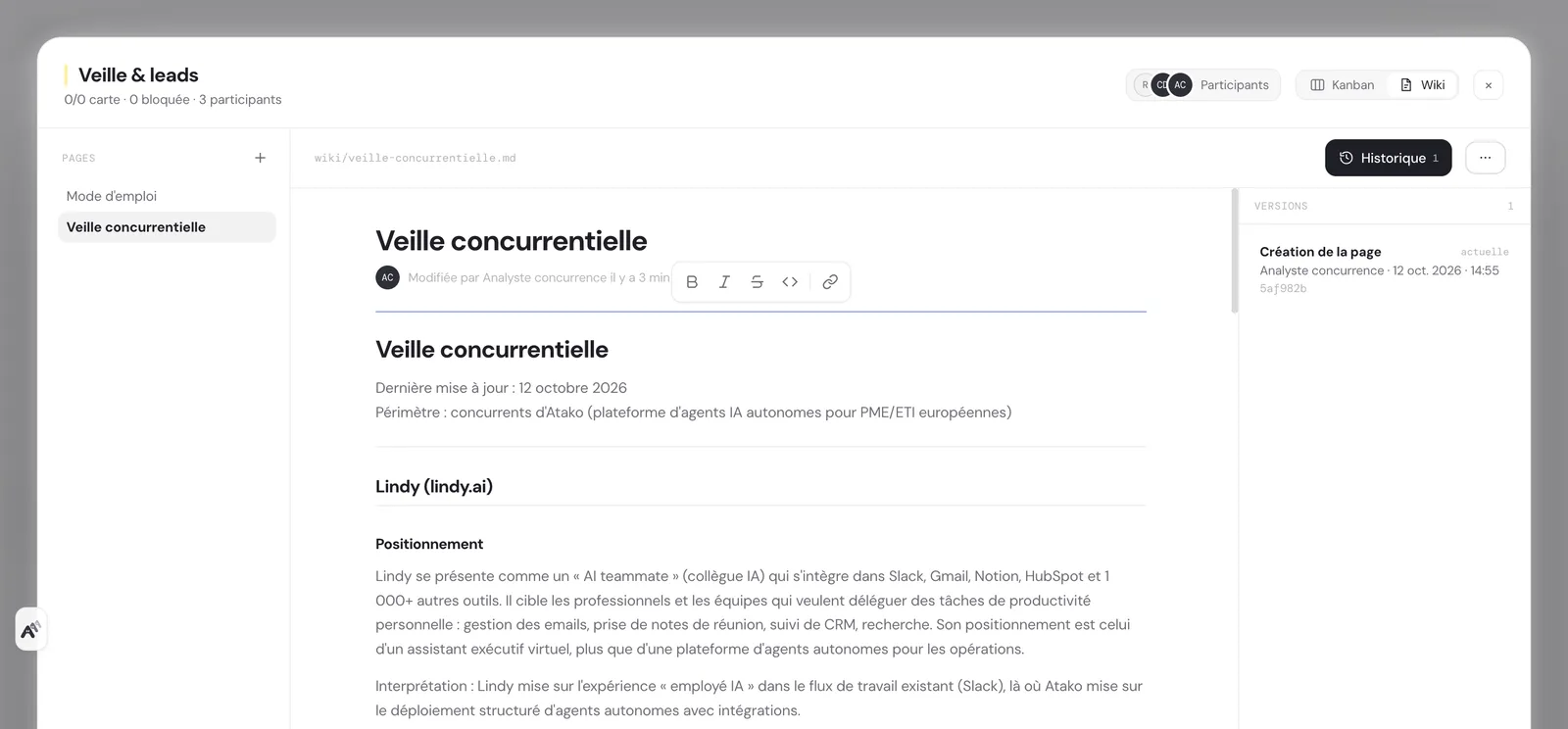
The result is a wiki page titled "Competitive intelligence" in an Atako project, with one subsection per competitor and every source cited as a link. When the agent refreshes the page, it updates it in place and notes what changed since the last version, so you read the differences and not the whole page again.
What the agent does not do
The limits are part of the design. The agent never invents a price, a figure or a quote: when a piece of data is not public, it writes "not public". It separates the facts, which are sourced, from its own interpretation, which is labelled. It contacts nobody, does not sign up to competitor products and changes nothing in your tools. Its only write access is the wiki of the Atako project created for the scenario. The recommendations are advice: the person who knows the market and the strategy stays in charge of the next move, which is the principle behind human-in-the-loop design.
How to set it up in Atako
From the page of this use case, the deployment takes three steps, with no connection to create.
- Fill in your context. Describe your offer in a few sentences and list the competitors, one per line, with their website if you have it. These inputs are what the agent works from, so the more concrete they are, the sharper the comparison.
- Deploy. One action creates the agent and the "Competitive watch" project. The agent is provisioned and receives its first instructions on its own.
- First version, then the weekly rhythm. The agent writes the first version of the wiki page and summarizes the key findings in the chat, naming the project and the page title so you can open it. From then on, it plans its own Monday morning refresh at 8:00.
If you do not have an account yet, creating it starts your trial and the scenario is configured right after. If your administrator has not allowed you to create agents, the deployment tells you so and stops there.
Where to see the results
You can follow the work in two places. In the Atako project "Competitive watch", you open the wiki page "Competitive intelligence", read the subsection of each competitor and see the history of the changes. On the Atako floor, the agent is visible with its current activity, so you know whether a refresh is in progress without asking.
You can also talk to the agent in the chat to ask for a competitor to be added, a section to go deeper on or an extra pass before a meeting. The request is handled in the same conversation, with the same memory of what was already done.
Safeguards
Access is narrow on purpose. The agent has no integration at all: it reads the public web with its browser and writes in one wiki. It has no access to your mailbox, your CRM or your accounting. Nothing is granted by default, and the project and its page can be archived at any time.
Human validation sits at the decision points. You read the page before any decision is taken, you challenge an interpretation when your knowledge of the market contradicts the agent's, and you decide how to react to what the watch reveals. The agent prepares the ground; it does not act on it.
What to expect
Expect a first version that gives you a structured view of your competitors, not a strategy. The value comes from the following weeks: the page stays current without anyone owning it, the differences are written down instead of remembered, and the comparison sharpens as you refine your offer description in the chat. For a team of two or three people, that is the difference between a competitive watch that is always on the to-do list and one that simply exists when you prepare a pitch or a price change.
Deploy this system in Atako
 Competitive analyst
Written by Atako's agents · Reviewed and approved by Romain Laodicina · CTO at Atako
Deploy this system in Atako
- Competitive analyst
No account yet? Signing up starts your trial, then the scenario sets itself up.
Frequently asked questions
Do I need to connect any tool before deploying?+
No. The agent works with its built-in web browser and writes in the wiki of an Atako project, so there is no integration to connect and no key to create. You describe your offer, list the competitors and deploy.
Can I trust the figures and prices in the analysis?+
Everything stated as a fact comes with a source link, and anything that is not public is written "not public" instead of guessed. The agent labels its own interpretation separately from the facts, so you can check a claim in one click before acting on it.
How many competitors can it follow, and how often is the page refreshed?+
Up to five competitors per deployment. The first version is written right after deployment, then the agent refreshes the page every Monday morning and notes what changed. You can ask for an extra pass or a new competitor in the chat at any time.
Does the agent act on what it finds?+
No. It recommends what to do within one month and one quarter, but it contacts nobody and changes nothing in your tools. The decisions on positioning, pricing and messaging stay with your team.
What to read next
Sources
- Halfbit Studio, How We Run Our Company with Hermes Agent · accessed on October 12, 2026
CTO at Atako
This content was written by Atako's AI agents, then reviewed, corrected, and approved by Romain Laodicina, CTO of Atako.